

Camera Buying Guide: 7 Things to Consider when Buying a New Camera
Buying a camera, whether you're shopping for your offset 1 or replacing 1 you already accept, can be an overwhelming feel. With tons of different brands, a range of camera categories, and an admittedly immense number of models, you have what feels like an infinite set up of choices. But if you keep a few things in listen, your buying procedure will be much simpler. Before you get-go shopping, think nearly these seven things.
Photographic camera Buying Guide to follow while buying a new photographic camera
1. What will you be using it for?
The answer to this question is the most important 1 in choosing a camera—not only is it very insightful in determining your priorities, only almost every other question is really a follow-upwardly question to this ane. And so it's crucial that you recollect carefully about the answer.
Let'south talk about what you might apply a photographic camera for. You might be thinking "to take pictures, duh," only there are a lot of dissimilar ways to respond this question. For example, you may use it for recording events with your friends and family unit, in which case you'll be using it at home, as well as at sporting events, bars, and cookouts. You might want to take high-quality pictures of your kids to keep for the future, from their beginning steps to their first baseball game. Perchance you want to get into photography as an fine art form and shoot landscapes and urban scenes.
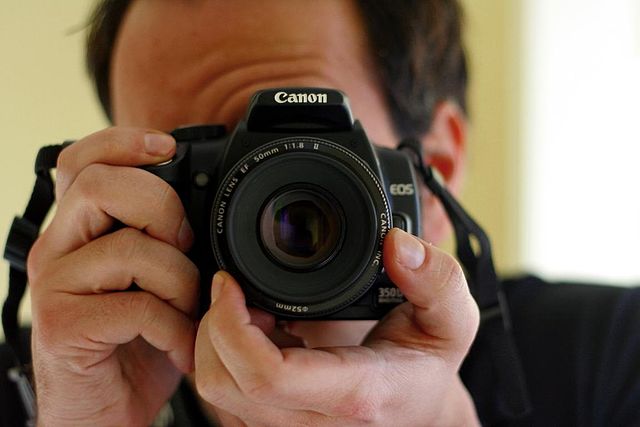
All of these are swell intentions for a camera, and each might touch your priorities in choosing one. If you're going to be bringing your photographic camera to different places to tape events with friends, you'll desire information technology to be very portable—perchance even pocket-sized. If you lot plan on doing outdoor photography on hikes and bike rides, you lot might consider something that's resilient and won't get damaged from small drops or getting splashed with water. Artistic photography and family unit pictures will benefit from a photographic camera that can produce very high-quality images.
These are the things to keep in listen when yous're reading through the following points. Every person has different needs when it comes to a camera, and information technology'southward important to really understand yours before you make a decision on which ane to purchase.
2. How much do you want to pay?
Cameras run the full range of prices, from $50 all the way upward to several thousands of dollars. And while the features yous desire volition determine the price y'all pay, information technology'southward a good idea to fix a price goal before you become started. You'll probably demand to adjust your goal, but knowing if yous can afford $200 or $800 tin can make a big difference in which cameras you look at.
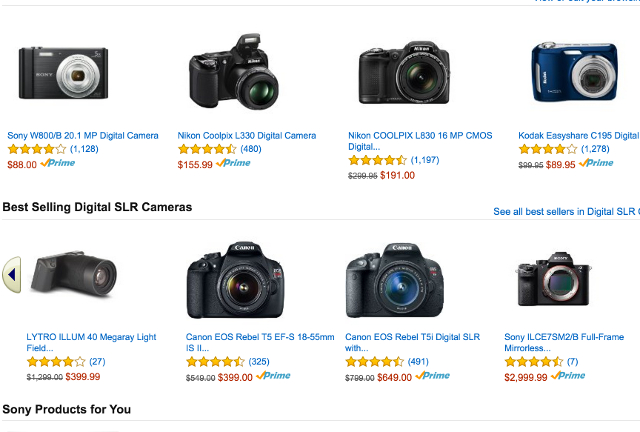
And remember; like with annihilation else, you get what yous pay for. If you spend $1,000, you're going to become higher-quality images and a lot more than useful features than if you spend $200. That'due south not to say that y'all can't go a great photographic camera for $200. Simply that you can wait different levels of performance at unlike price points.
Exercise yous have a price in mind? Skillful—let's go started in looking at specific decisions.
iii. DSLR or point-and-shoot?
A digital single-lens reflex camera (DSLR) is what you might telephone call a "serious camera." These are the types of cameras that yous'll see professional photographers and amateur enthusiasts using. There are a number of factors that make for much nicer images than you'll get from other types of cameras—they take bigger sensors, more than versatile lenses, better processing capabilities, and other features that gear up them apart (we'll talk over several of these in the coming sections). On the other hand, they're much larger and more expensive than bespeak-and-shoot cameras.
Point-and-shoots (or "compacts") are probably what y'all're familiar with; they're small, accept a retractable lens, usually but include an electronic viewfinder, and don't produce pictures on par with the ones yous'll get from a DSLR. They are, still, much more than portable and significantly more than affordable.
There's also a type of photographic camera that falls between these two—the interchangeable-lens camera, besides known as a bridge camera or an EVIL (electronic viewfinder interchangeable lens) camera. These combine the small size and portability of a bespeak-and-shoot with the interchangeable lenses and picture quality of a DSLR. As yous can meet in the video above, they fall right in the heart. If you desire a fiddling fleck of everything, this type of photographic camera volition be a good bet.
An important thing to remember is that DSLRs offering a great bargain more command over your photography than signal-and-shoot cameras, and this can exist a big selling point. Both styles of photographic camera will use algorithms and programs to help you have the all-time pictures possible, just if you desire manual control over your settings (to become a specific effect or overcome some of the limitations of the brain within your photographic camera), a DSLR is the manner to go.
Each blazon of photographic camera comes in a variety of price ranges and feature sets—at that place are betoken-and-shoots that create gorgeous images, and at that place are DSLRs that are small enough to fit comfortably in a small shoulder bag. Remembering your main priorities will help you choose between the three options here.
four. How many megapixels do you need?
When most people await at cameras, they look get-go at the number of megapixels the camera has, and immediately assume that more than megapixels means better images. And to a point, this is truthful. But the issue is more complicated than that. Let's take a quick look at how a digital camera works in this fantastic graphic from Digital Camera World:
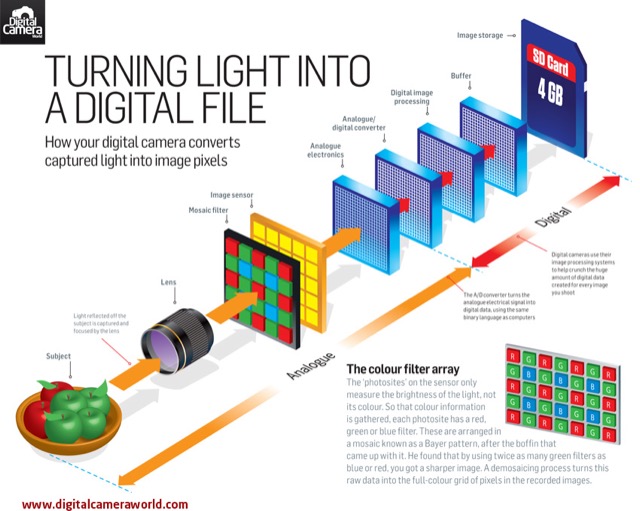
As you can run across, light travels through the lens and hits the sensor, where it'south recorded. The number of megapixels tells you how many sensor elements there are—so if you have a 16 MP photographic camera, there are 16 million pixels that will exist recorded. It seems similar the more megapixels you have, the better image you'll get, correct? Not exactly.
If you have tons of megapixels on a small sensor, your camera could be trying to cram as well much information into a small space, resulting in prototype racket and a lack of clarity. Camera manufacturers are getting better all the time at dealing with this issue, but it's still something to continue in mind.
What's more important than megapixels is sensor size.
five. Which sensor size makes sense for you?
A sensor can be idea of as the "film" of the photographic camera. Before the rising of digital SLRs, cameras used 35mm film, meaning the film that captured calorie-free was 35mm wide. Today's highest-quality DSLRs are called "total-frame," and their sensors are 35mm wide. These will go you lot the best pictures—but they'll besides price you a lot of money, and they're quite large. The Catechism EOS 6D, for instance, goes for $$i,400 on Amazon. And that's without any lenses.
If yous want the accented all-time quality images, a full-frame DSLR is the manner to go. These cameras aren't the best selection for nearly people, though, because of their size and cost. The next step downwards in sensor size is APS-C, which is found in nigh entry- and mid-level DSLRs. These sensors are in the 20–28mm range, which is still plenty large for the vast majority of amateur photographers.
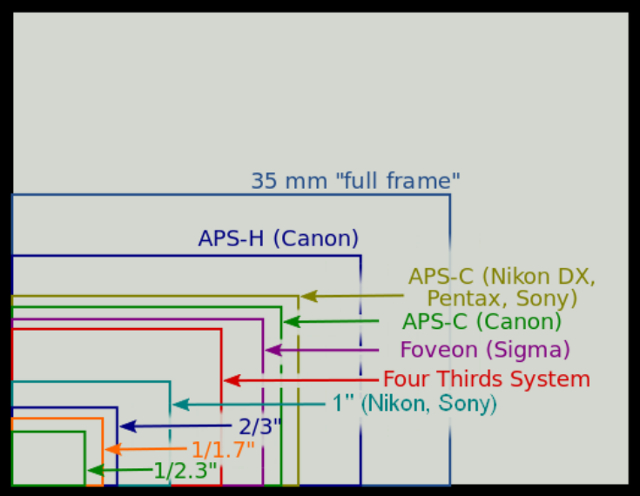
Moving down i step, nosotros take Micro Four Thirds (MFT). This sensor size falls squarely between DSLRs and most point-and-shoots. At about 18mm wide, MFT sensors won't capture as much light equally APS-C sensors, but they will provide a noticeable advantage over signal-and-shoot sensors. The biggest advantage of these sensors is that they're quite a scrap smaller and lighter than APS-Cs, making for more than portable cameras that can create high-quality images (the Olympus PEN Due east-PL6 is a not bad example of an MFT photographic camera that combines the two).
One time yous go beneath MFT, sensor sizes tin can vary quite a chip. At that place aren't many standard point-and-shoot sensor sizes, then you'll need to cheque the manufacturer's website to get the most accurate information. This Nikon Coolpix L32, for instance, has a sensor size of 1/ii.3″.
To sum it all up, the larger sensor your camera has, the meliorate pictures you'll get. The tradeoff mainly lies in expense.
6. How much zoom do yous need?
Another matter that might draw your attention to a camera is the amount of zoom that it advertises. It used to exist that 3x zoom was a solid amount, but today's point-and-shoot cameras offering 10x, 20x, and fifty-fifty higher levels of zoom. Plain, more zoom means more versatility—if y'all tin can fill the frame with your discipline at a distance, you're going to get better pictures.
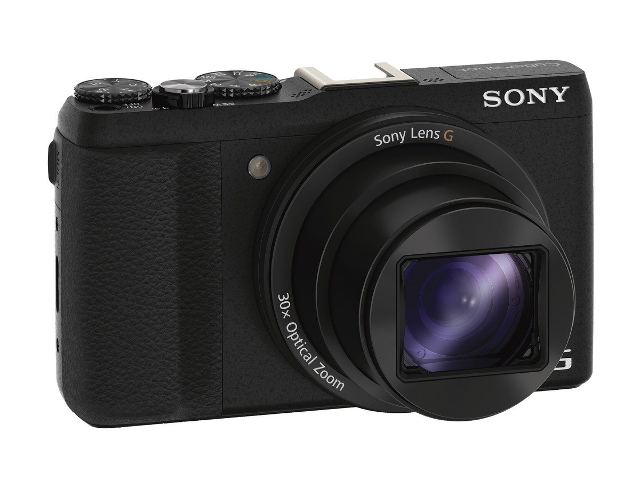
DSLRs don't list a zoom factor, because you can supercede the lenses and get dissimilar levels of zoom. Most DSLRs come with an eighteen–55mm lens, the standard "do-it-all" size. Simply you can too add telephoto lenses with lengths of 200mm, 300mm, and beyond. If yous desire the ability to zoomstyle in on a discipline, a camera with interchangeable lenses volition serve you amend.
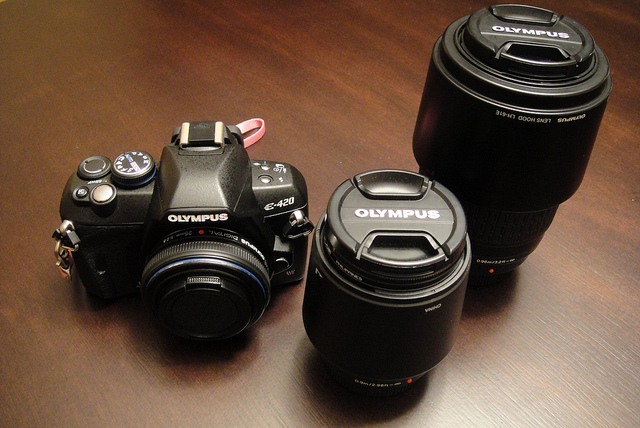
If you lot decide to go with a point-and-shoot camera, make sure that the zoom measurement you focus on is optical zoom. This is in dissimilarity to digital zoom, which merely enlarges the pixels on your prototype and results in a much lower-quality pic. If you're deciding between a camera with 3x optical zoom and 10x digital zoom or a more than expensive camera with 10x optical zoom, the latter volition give you much better performance.
7. Will you be making upgrades in the future?
If you lot're looking for an affordable camera to have on family trips, you lot don't need to worry about upgrading in the future. You lot'll probably spend a couple hundred dollars, and be happy to spend a couple hundred more in five years when yous need to replace you photographic camera. If you're interested in photography as a hobby, however, the upgradeability of your camera is something you might want to think about.
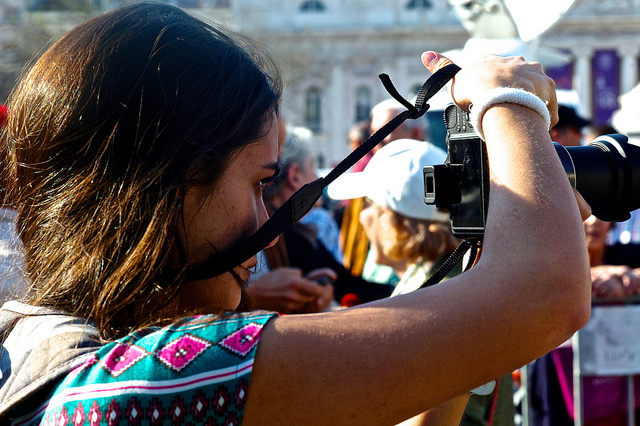
Most photography enthusiasts showtime out with a single lens and a few accessories—a camera bag and a tripod, maybe. Only if you find that photography is a bully hobby that you lot'd like to get more into, it will be advantageous if y'all can upgrade your camera without having to entirely replace it. On a DSLR, for example, you can buy new lenses, external flashes, neutral density filters, replacement straps, and all sorts of other improvements. A bridge camera will accept other lenses, giving you more versatility.
It's more expensive to outset with a DSLR or a bridge camera than a point-and-shoot, but you could cease up saving money in the long run if yous don't have to completely replace your camera when y'all want an upgrade.
See ALSO: 10 Best Photo Sharing Sites
Exercise Some Planning, then Buy!
The huge amount of information out there—too as the heed-boggling choice of cameras available—can be paralyzing. But don't fret; recollect through each item on this listing, and you'll ameliorate understand your priorities, which will help shape the best options for your new camera. Later on you've washed that, make a decision, buy a camera, and get out to take some pictures! (If yous think you'd like a DSLR, don't miss our article on the best entry-level DSLRs of 2015.)
What else practice yous consider when yous buy a new camera? Share your thoughts beneath!
Image credits: Nicolás García, Moxfyre via Wikimedia commons, Calgary Reviews, Pedro Ribeiro Simões via Flickr.

Source: https://beebom.com/camera-buying-guide/
Posted by: jacksonjustong67.blogspot.com
0 Response to "Camera Buying Guide: 7 Things to Consider when Buying a New Camera"
Post a Comment